 Add us as a preferred source on Google
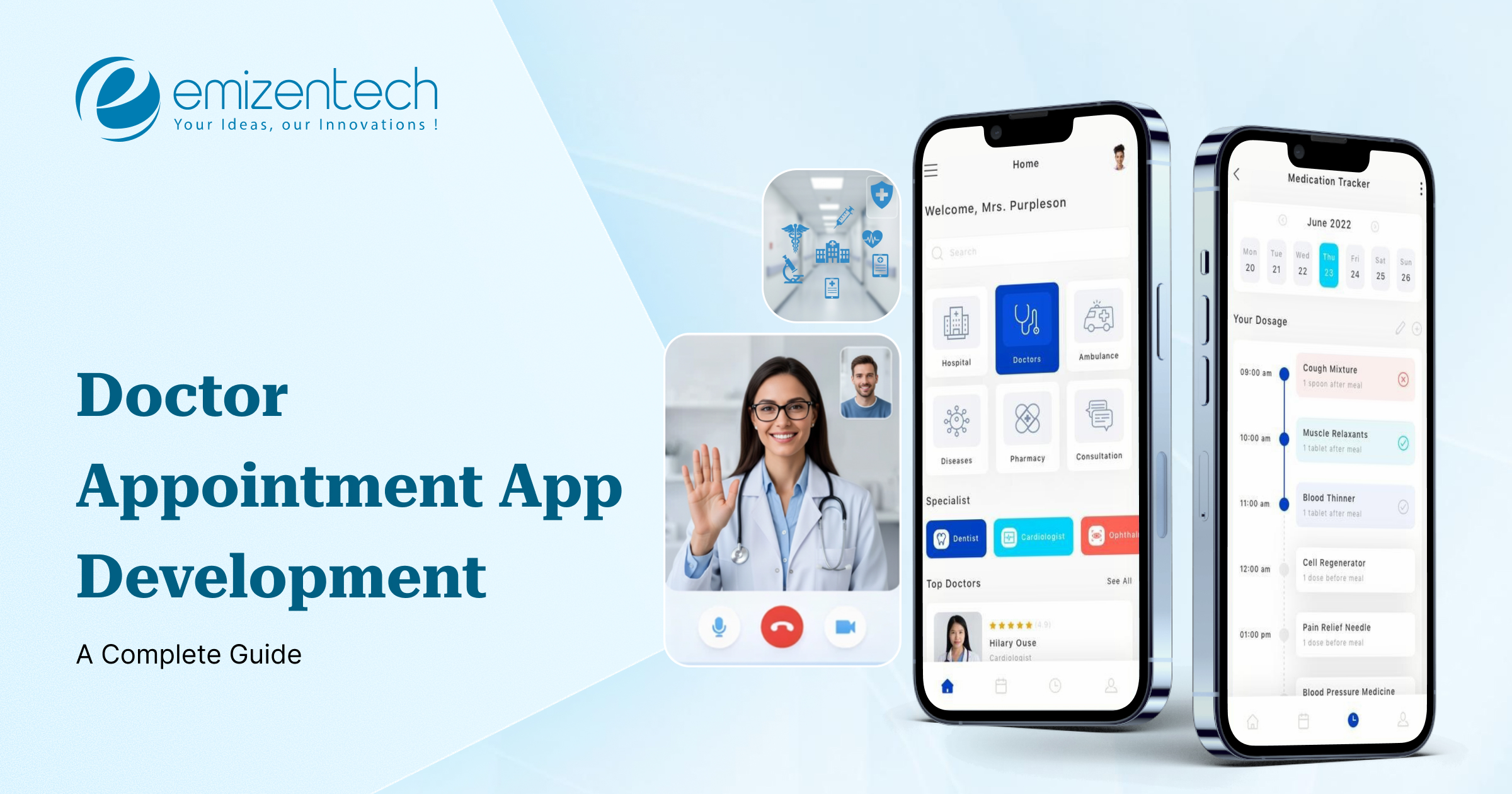
Are you looking to revolutionize patient care while capitalizing on a rapidly expanding digital market? Figuring out how to develop a doctor appointment booking app is basically the go-to route for shifting modern healthcare delivery into something more efficient.
Precedence Research estimated the global digital health market size to be USD 420.08 billion in 2025 and expected to grow from USD 483.07 billion in 2026 to USD 1,171.24 billion by 2035, at a CAGR of 10.8% from 2026 to 2035.
Investing in custom doctor appointment app development helps healthcare organizations smooth their workflows, reduce no-shows, and deliver care that feels more connected. This guide covers what you need to know to launch a compliant, scalable digital healthcare solution that can actually perform this year.
What Is a Doctor Appointment App and Why Should You Invest?
A doctor appointment app is a secure digital platform that connects patients with healthcare providers. It simplifies the whole booking flow, reduces admin headaches, and makes medical access easier, which is why doctor appointment app development is often seen as one of the most lucrative healthcare business ideas for forward-thinking investors today.
Businesses can take advantage of a rapidly growing digital market by investing in custom medical software. It ensures consistent recurring revenue, modernizes clinical workflows, and satisfies the growing consumer demand for immediate, round-the-clock access to healthcare.
- Expanding Market Demand: People really want instant, 24/7 digital booking instead of doing everything by phone calls and waiting on hold, again and again.
- Operational Efficiency: Operational efficiency also improves because it reduces administrative overhead, manual scheduling errors, and costly patient no-shows.
- Enhanced Engagement: Patient retention gets a noticeable push via automated medication alerts, follow-up nudges, and digital health tracking that stays consistent between visits.
Types of Doctor Appointment Apps
The digital healthcare ecosystem is fairly diverse, so picking the right approach during doctor-appointment-booking-app development matters a lot. If you choose well, your solution can fit your intended audience and also match the real medical operational needs, not just the obvious features.
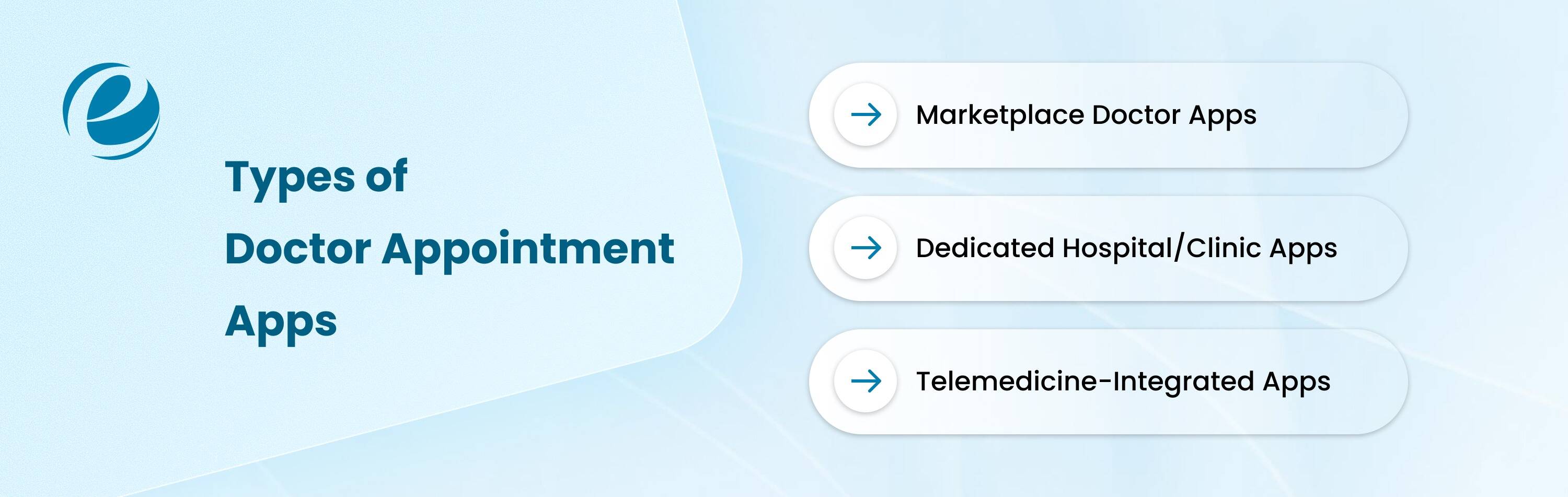
Marketplace Doctor Apps
These kinds of platforms work a bit like aggregator networks, so patients can scroll through large directories of different independent specialists, check verified feedback, and set up visits depending on real availability. They’re a great fit for on demand app development teams that want to grow a broad patient reach fast and not be too constrained.
Dedicated Hospital/Clinic Apps
Built specifically for one healthcare org or maybe a multi-clinic chain, these solutions sync straight into the internal hospital databases. This makes patient administration smoother. supports secure internal messaging and can boost specialized patient retention, but only for that one medical brand.
Telemedicine-Integrated Apps
These combine appointment booking with remote care, meaning patients can reserve time slots and then just join virtual consultations right away. With proper telemedicine app development frameworks in place, the experience stays stable, high-definition video works well, remote diagnostics get easier, and electronic prescriptions can be issued instantly.
Benefits of Doctor Appointment App Development
Investing in doctor appointment booking app development brings major changes to the entire healthcare ecosystem. It contributes to the modernization of daily operations, enhances the utilization of medical resources, and ultimately improves the patient experience. Most significantly, it streamlines healthcare operations by automating repetitive scheduling tasks, allowing administrative staff to focus on urgent patient needs.
For Doctor Appointment App Providers
Platform owners can really squeeze out profit from highly profitable, scalable monetization schemes like premium featured listings, transaction charges, and in-app advertising. It helps them set up a solid digital footprint within the lucrative space of specialized doctor on demand app development services, kind of like a fast-moving marketplace.
For Healthcare Providers
Medical teams can automate complicated scheduling, cut down admin load big time, and keep the daily appointment calendars more coherent. In practice, it helps prevent burnout, reduces expensive patient no-shows with automated follow-ups, and pushes the clinic’s overall daily revenue generation higher, day after day.
For Patients
Patients get the real convenience of booking, rescheduling, or canceling medical visits 24/7, without having to wait on hold for long phone calls. They also receive timely automated reminders, can access digital prescriptions right away, and can handle family health records with less hassle, all in one place.
Essential Features to Consider in Doctor Appointment App Development
To build a competitive platform, your doctor appointment app development process has to tick in a solid core feature set. These key tools do the job for basic user needs and keep things running smoothly day to day, for both patients and clinicians, even when schedules get chaotic.
Patient Profile & Registration
A secure onboarding flow lets patients register through email or social sign-ins. This part handles personal details, medical history, emergency contacts, and also insurance documentation in a protected way, all while keeping strict data privacy rules in place.
Doctor Directory & Advanced Search
With this feature, patients are able to filter their search for medical specialists by location, medical specialty, years of experience, patient ratings, and consultation fees. It helps users find the right care provider fast in an intuitive way.
Online Slot Booking & Scheduling
A real-time calendar system shows patients available medical slots and lets them lock an appointment immediately. It also avoids double-booking mix-ups and sends instant confirmations via SMS, email, or direct push alerts, depending on what the user picked.
Multi-Channel Communication
By adding secure in-app text chat, plus audio calling with clear quality, and video conferencing, patients and doctors can interact more naturally. This capability matters when someone is explaining symptoms, sending digital reports, or doing those follow-up consultations.
Secure Payment Gateway Integration
Adding well-known payment gateways lets patients pay consultation fees easily using credit cards, mobile wallets, or insurance-related claims. Security controls, including PCI-DSS compliance, are built in here too, so transactions stay safer and the overall healthcare app development cost is easier to manage.
Advanced Features That Improve Your Doctor Appointment Booking App in 2026
To dominate the competitive medical landscape, your app needs cutting-edge functionalities, not just basic ones. Infusing next-generation technologies improves market positioning and delivers a more refined user experience during doctor appointment booking app development, creating a more premium and seamless experience for users.
AI-Powered Symptom Checkers
When you integrate advanced algorithms, patients can enter their symptoms and get some preliminary guidance before they even book an appointment. By using AI in healthcare, you can route patients to the right medical specialist faster, which helps optimize the clinical intake pipeline.
Automated Waiting Room Management
This feature provides real-time updates to patients about their queue position, whether the clinic is virtual or physical. It helps reduce waiting anxiety, improves clinic flow, and enhances overall user satisfaction. It also makes the entire appointment process more organized and efficient.
IoT & Wearable Device Integration
Pairing the app with smartwatches and other medical wearables allows continuous tracking of vital signs, things like heart rate and glucose readings. Then doctors can review that continuous health telemetry data for highly accurate remote patient monitoring and less guesswork during follow-ups.
Cloud-Based EHR/EMR Integration
By integrating with electronic health record (EHR) systems, physicians gain instant and secure access to comprehensive patient histories. This supports more informed clinical decisions, accelerates prescription workflows, and eliminates fragmented data silos that reduce operational efficiency.
Tech Stack for Doctor Appointment App Development
Choosing a secure and highly scalable technology stack is crucial to creating an elite medical platform. The chosen frameworks should be high-performing, able to increase traffic, and easily able to comply with the strict global healthcare data regulations.
| Layer / Functional Category | Recommended Technologies |
| Mobile Frontend (Client-Side) | Flutter, React Native, Swift (iOS), Kotlin (Android) |
| Backend & Core Logic | Node.js, Python (Django/Flask), Java (Spring Boot) |
| Database Management | PostgreSQL, MySQL, MongoDB |
| Telehealth Infrastructure | WebRTC, Twilio Video SDK, Agora.io |
| Medical Interoperability | HL7 FHIR APIs (Epic, Cerner integration) |
| Payment & Processing | Stripe, Braintree, PayPal SDK |
| Notifications & Messaging | Firebase Cloud Messaging (FCM), Twilio |
| Cloud Hosting & DevOps | AWS (Amazon Web Services), Microsoft Azure |
Step-by-Step Process for Developing a Doctor Appointment App
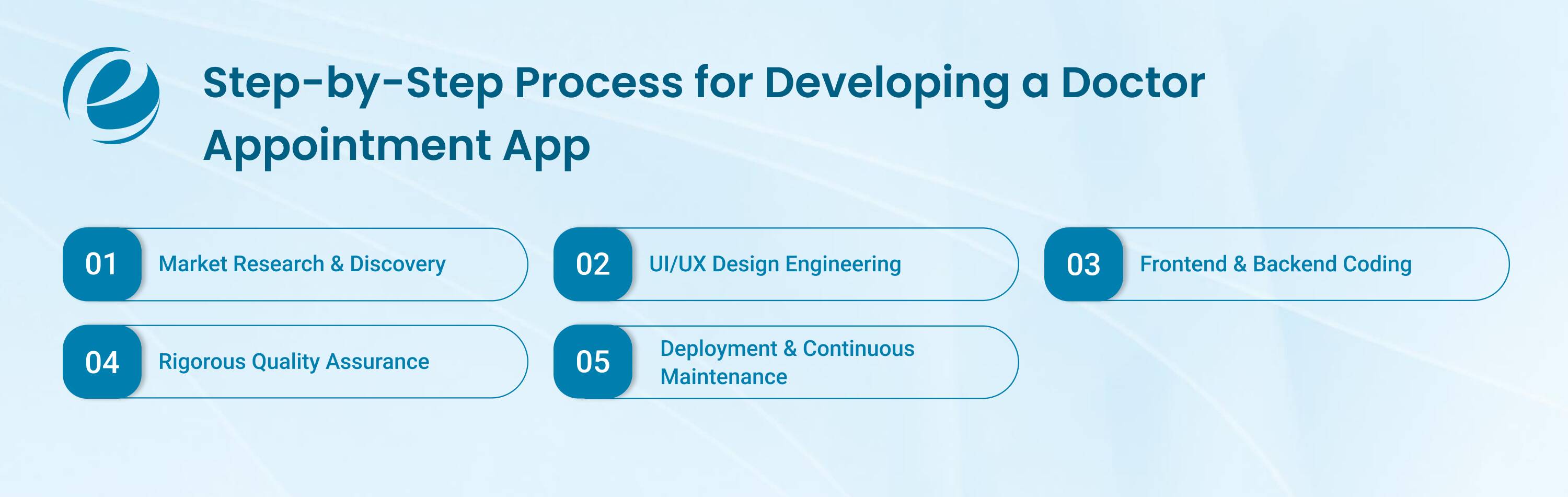
Understanding how to build a doctor appointment booking app really means you have to follow a bit of a structured, strategic dev process. It helps with regulatory compliance, keeps the architecture stable, and usually improves the app’s performance once it goes live.
Phase 1: Market Research & Discovery
Look at competitor apps, decide on user personas, and outline what makes your product “different” in a way people actually feel. In this early stage, you identify the exact needs and ensure the offering aligns with HIPAA-compliant app development expectations, not just generic healthcare ideas.
Phase 2: UI/UX Design Engineering
Design wireframes, create interactive user flows, and craft modern visual screens for different demographics. Also push high accessibility standards, use clean layouts, and keep navigation paths simple so booking feels effortless, even if someone is using the app on a tight schedule or limited bandwidth.
Phase 3: Frontend & Backend Coding
The development team writes maintainable, scalable code for the client and the server side. Then you connect everything via APIs, set up secure payment logic, handle real-time calendars, and ensure communication features (like reminders or messages) work smoothly.
Phase 4: Rigorous Quality Assurance
QA engineers run repetitive automated checks and manual reviews to squash bugs, identify performance slowdowns, and reduce security vulnerabilities. Testing should validate strong data encryption, reliable cross-platform performance, and consistent functionality even under high-traffic conditions, not just during low-usage scenarios.
Phase 5: Deployment & Continuous Maintenance
After completion, the app gets released to the Apple App Store and Google Play Store, but only after compliance audits are cleared. Post-launch, you keep monitoring, apply security fixes on time, and ship ongoing improvements so the app stays current and remains competitive in the market.
Doctor Appointment App Development Cost in 2026
Figuring out the budget for digital healthcare solutions tends to be a bit messy because you’re dealing with architectural choices, regional differences, and staffing realities. By 2026, the starting capital outlay for custom software work can land anywhere around $30,000 to $350,000+, heavily influenced by regulatory demands and feature depth.
Cost by Development Phase
Breaking the build into separate stages makes it easier to put money where it should go. When you plan for things like compliance mapping, UX prototyping that’s actually strict, and then the frontend/backend engineering part, you usually get a more reliable and safer delivery.
| Development Phase | Cost Range (USD) | Focus Area |
| Discovery & Compliance | $8,000 – $20,000 | PHI mapping, regulatory planning, and market research |
| UI/UX Design & Prototyping | $10,000 – $40,000 | Wireframes, accessibility blueprints, and user flows |
| Frontend Development | $20,000 – $80,000 | Client-facing coding for iOS, Android, or cross-platform |
| Backend & Secure Logic | $30,000 – $120,000 | Database setup, API creation, and encrypted server logic |
| QA, Audits & Deployment | $15,000 – $45,000 | Penetration testing, security checks, and app store launch |
Cost by App Complexity
How many features you want and what tech stack you pick will decide the workload. If you’re building simple appointment workflows, it’s usually cost-efficient, but when you start adding advanced tools, the engineering effort grows fast, like a lot more hands and time.
| Complexity Level | Cost Range (USD) | Key Functionalities Included |
| Basic MVP App | $25,000 – $60,000 | Manual slot booking, basic patient profiles, text alerts |
| Mid-Level App | $60,000 – $150,000 | Telemedicine video calls, EHR syncing, multi-gateways |
| Enterprise Ecosystem | $150,000 – $350,000+ | AI symptom tracking, IoT wearable sync, predictive scheduling |
Cost by Engineering Team Roles
Putting together a dedicated cross-functional crew means you need multiple kinds of experts working together. The specialist hourly pricing tends to pile up, especially based on how long your active development window lasts.
| Team Role | Average Hourly Rate (USD) | Core Responsibility |
| Project Manager / BA | $40 – $120 / Hour | Scope alignment, timelines, and business requirements |
| UI/UX Product Designer | $35 – $100 / Hour | Visual assets, layouts, and interactive prototypes |
| Mobile App Developer | $40 – $150 / Hour | Platform-specific coding and internal logic execution |
| Backend Engineer | $50 – $160 / Hour | Server management, API bridges, and database security |
| QA / Penetration Tester | $35 – $90 / Hour | System debugging, stress testing, and vulnerability checks |
Cost by Geographic Region
The location of the software partner you choose is still arguably the biggest single driver of your overall hourly rate and, therefore, your final spend. Even small regional differences can change the entire bottom line.
| Geographic Region | Average Hourly Rate (USD) | Estimated Total Project Cost (USD) |
| North America | $100 – $180 / Hour | $120,000 – $300,000+ |
| Western Europe | $80 – $150 / Hour | $100,000 – $250,000 |
| Eastern Europe | $35 – $70 / Hour | $50,000 – $110,000 |
| Asia (India/Philippines) | $20 – $50 / Hour | $30,000 – $80,000 |
How Long Does it Typically Take to Develop a Doctor Appointment App?
The development timeline for a doctor appointment app largely depends on the platform architecture, feature complexity, third-party integrations, and compliance requirements. In practice, a typical doctor appointment booking app development roadmaps usually run for months, progressing through highly organized, sequential phases.
| Development Stage | Estimated Timeline | Core Focus Areas |
| Discovery & Planning | 2 – 3 Weeks | Scope Definition, Compliance Mapping, Wireframing |
| UI/UX Design UI | 3 – 5 Weeks | Interface Visuals, User Journeys, Prototypes |
| Core Development | 10 – 16 Weeks | Backend Architecture, Frontend, API Integrations |
| Testing & Compliance | 3 – 4 Weeks | Security Vulnerability Auditing, QA, Bug Fixing |
| Deployment & Launch | 1 – 2 Weeks | App Store Submissions, Production Server Setup |
App Development Timeline & Structural Differences
Selecting the right project scope directly impacts your product’s time-to-market. Development timelines typically expand alongside structural complexity, ranging from rapid prototype delivery to multi-month enterprise-grade engineering and deployment cycles.
| Project Complexity Type | Estimated Timeline | Core Feature Scope | Critical Integration Layer |
| Simple App (MVP) | 3 – 5 Months | Manual slot scheduling, basic patient profiles, automated push/SMS notifications, and standard feedback ratings. | Simple third-party payment APIs (e.g., Stripe) and local calendar sync. |
| Average Complexity App | 5 – 7 Months | Real-time, HIPAA-compliant video consultations, automated clinic queue workflows, insurance validation portals, and prescription generation tools. | Basic EHR/EMR cloud sync and multi-channel secure communications APIs (such as Twilio). |
| Advanced App (Enterprise Ecosystem) | 7 – 12+ Months | AI predictive appointment booking, tracking symptom triage, ingestion of vital data from IoT wearables, and organizational dashboards across clinics. | Enterprise-grade EHR networks (Epic, Cerner, Athenahealth) with secure FHIR APIs |
Best Practices for Successful Doctor Appointment App Development
Building a top-tier platform requires following proven industry standards and development practices. Using appropriate technical strategic guidelines during doctor appointment app development ensures a dependable, legally sound, and highly marketable product.
Prioritize Ironclad Regulatory Compliance
Medical applications must comply with regional healthcare regulations, such as HIPAA in the United States or GDPR in Europe. Implementing end-to-end data encryption, multi-factor authentication, and detailed secure access logging helps safeguard sensitive patient data from breaches, even when the unexpected happens.
Focus on User-Centric UI/UX Design
Healthcare apps are used by all kinds of people, including elderly users and individuals dealing with serious medical distress. Creating accessible, intuitive, clutter-reduced screens so they can actually schedule critical appointments fast, like within seconds, and without that annoying digital friction.
Optimize for Scalable Cloud Infrastructure
Choose a high-performance cloud hosting provider that can handle sudden spikes in simultaneous user connections. If you build on a scalable microservices architecture, you reduce the chances of downtime, keep loading speeds steady, and make future expansion simpler instead of painful later.
Ensure Seamless Multi-Platform Optimization
Patients and medical professionals don’t just use one device. They jump between iOS, Android, and web browsers. Using responsive cross-platform frameworks helps keep performance consistent, the visuals match properly, and real-time data synchronization works across all those different devices.
Implement Automated Data Backups
System failures or network issues shouldn’t ever cause lost patient medical records or random scheduling confusion. Like, you want cloud-to-cloud backup workflows that are robust and automated so the database stays intact and recovery happens right away, even during unexpected operational outages.
Monetization Strategies for Doctor Appointment Apps
To generate a strong return on your doctor appointment booking app development investment, it is important to pick sustainable and scalable revenue models. Combining multiple monetization strategies can create more consistent revenue streams while continuing to deliver long-term value to patients, healthcare providers, and platform users
Commission-Based Model
Charge a fixed fee or percentage commission for every completed medical consultation processed through the platform. This model allows revenue to scale alongside appointment volume and provider network growth.
Premium Subscription Plans
Offer monthly or annual subscription plans for both patients and healthcare providers. Premium tiers can include features such as advanced analytics for clinics, priority appointment scheduling, telemedicine access, and enhanced patient management tools.
Featured Clinic Listings
Let individual medical practitioners, or even bigger hospital networks, pay a premium fee to boost their digital visibility. Featured medical profiles then show up near the top of patient search results, which helps generate more booking volumes for those providers pretty quickly.
In-App Advertising Channels
Partner with relevant third-party businesses, wellness, and pharmaceutical brands to display targeted, non-intrusive advertisements within the application. Relevant advertising can generate additional revenue without disrupting the user experience.
Corporate Wellness Partnerships
Offer your platform as a broad corporate health benefit package and sell it directly to companies that want to improve employee wellness. With this B2B approach, you can expect very stable, recurring contractual revenue while also expanding your patient network quickly, almost as a snowball effect if the onboarding is done right.
Five Examples of Popular Doctor Appointment Booking Apps
Therefore, with the advantages of developing an online appointment scheduling system in mind, let’s consider developing this technology as an expenditure from which you could quickly profit. Look at well-known applications for scheduling doctor appointments, like Doctolib, Practo, and ZocDoc HealthTap.
You’ll observe the numerous advantages these applications have for patients and healthcare professionals utilising them. It’s hard to overlook the opportunity to make money from medical on-demand services by using appointment software. Let’s take a closer look at each illustration.
ZocDoc
ZocDoc is a platform where doctors advertise their expertise. And customers schedule appointments with doctors. It was founded in 2007. To assist patients in finding providers in more than 50 specialties, ZocDoc employs AI. Patients may search their insurance policies to find physicians who provide these therapies, which is one of the system’s standout advantages. For iOS and Android, this software offers both native mobile applications and web versions.
HealthTap
Patients can download the HealthTap app for a monthly fee. It was established in 2007. This software enables users to set up medical visits through video conversations or live chat. The business provides insurance providers, medical professionals, and other employee-related items with a paid B2B medical centre. You may start using HealthTap online or through specific smartphone platforms.
Doctor On Demand
On-demand and planned appointments with US-licensed healthcare professionals are available through the telemedicine platform Dr. on Demand. It uses a flat fee-based business model for the Doctor on Demand app. Every time a patient sees a doctor, they pay a specific cost. Android, iOS, and web-based mobile applications. Online health consultations are the main emphasis of Physician on Call.
Practo
Practo, a 2008 startup, has 5 million Google Play installations. By giving its fans more, this popularity is increased. With the help of this app, people may plan online doctor visits, submit medications, make pill reminders, arrange for physical examinations, and order medicine. Practo covers all internet and digital platforms.
Doctolib
Doctlib, a French unicorn, was established in 2013. Based on the kind of membership, its software and applications allow customers to book doctors’ appointments. It offers the potential of telehealth visits, payments, physician and patient portfolios, and other utility programs. Sixty million individuals presently use Doctolib in France, Austria, and Italy, with 300,000 professionals; most of them have used the service to schedule a visit.
Why Choose Emizentech for Your Doctor Appointment App Development?
Working alongside an elite digital engineering agency really matters when you’re trying to launch a top-tier product. Emizentech focuses on premium doctor appointment app development, delivering secure, legally compliant, and modern software that is custom-tailored to your business needs.
Proven Healthcare Domain Expertise
Emizentech has years of specialized experience building complicated, cross-functional medical software architectures. Our development teams understand medical workflows at a practical level, so we can build solutions that address real clinical and operational problems, not just “generic” app requirements.
Mastery of Regulatory Compliance
We prioritize data security by following strict development protocols that align with major global healthcare regulations. Our engineering teams implement advanced security measures to help your platform achieve regulatory compliance during custom HIPAA-compliant app development.
Agile Engineering Methodologies
Our transparent, agile development frameworks keep you engaged during the whole project lifecycle, not just at the beginning. We deliver working software iterations continuously, collect active feedback, and then pivot quickly so your exact product intent actually gets realized.
Cutting-Edge Technical Stack
Emizentech uses advanced programming languages, cloud systems, and modern frameworks. Whether we are weaving in AI diagnostic capabilities, blockchain ledgers, or high-level analytics, we craft solutions that scale well and are built to flex with upcoming digital health trends.
Comprehensive End-to-End Support
From initial product ideation and UI/UX planning to deployment and post-launch maintenance, Emizentech serves as a dedicated technology partner throughout the development lifecycle. The team provides ongoing support, continuous feature enhancements, and infrastructure monitoring to help maintain long-term product performance and scalability.
Final Words
Launching a custom platform via professional doctor appointment app development is an effective way to improve patient care while strengthening your position in the digital healthcare market. When you include key feature sets, enforce ironclad data protection, and use scalable monetization pathways, your business can push for better long-term returns.
Partnering with a specialist development firm like Emizentech helps ensure your software meets high technical and regulatory standards. Reach out to our expert engineering team to transform your idea into a scalable and competitive digital healthcare solution.
FAQs
Which technology is best for healthcare app development?
Mostly cross-platform frameworks like Flutter and React Native do a lot of the heavy lifting for the frontend; then Node.js or Python handles the backend side, and that part is scalable too. When you pick the right technology stack, you’re basically tuning the whole healthcare app development cost, and you also keep performance running smoothly.
Is HIPAA compliance mandatory for healthcare apps?
Yes, in the US, it’s mandatory if your app touches protected health information, or PHI. So if you are building a doctor appointment app, you should treat HIPAA like it matters a lot. Secure data encryption, strong access control measures, plus audit logs help protect the users’ data integrity without guessing later.
Can AI improve doctor appointment scheduling systems?
Yes, definitely. Adding AI in healthcare helps with predictive scheduling, queue management automation, and even smarter symptom checkers. That cuts down no-shows, it helps optimize provider calendars, and it makes the entire healthcare scheduling ecosystem feel more reliable, more responsive.
What is the difference between telemedicine and doctor appointment apps?
Doctor appointment apps mostly concentrate on scheduling, calendar oversight, and the administrative logistics around a medical visit. Telemedicine apps go beyond that by adding virtual care tools, for example, encrypted real-time video consultations and remote diagnostics. So one thing is coordination, and the other is direct virtual care, a kind of different angle.




 +1 (989) 535-9295
 info@emizentech.com
 emizentech


