 Add us as a preferred source on Google
Key Takeaways
- B2B ecommerce sales increased 13% to $2.93 trillion in 2025 as total US manufacturing & distribution sales grew only 0.4%.
- By 2024, 39% of B2B buyers will spend more than $500,000 on a single order they place themselves or from a distance.
- Manufacturing ecommerce needs account-specific pricing, PO payments, punchout/EDI support, and ERP integration.
- Choose a model (B2B, D2C, B2B2C, or hybrid) that fits your existing distribution relationships.
- No platform is best for everyone. Match it to your catalog complexity, ERP, and budget.
- Clean product data and ERP integration decide whether a project succeeds.
- Expect 3-6 months for a Shopify Plus or BigCommerce launch and 6-12+ months for complex enterprise builds.
- Track online order share, cost per order, and ROI from day one.
Consider these numbers for a moment. US manufacturing and distribution sales hardly moved in 2025, growing 0.4% according to Digital Commerce 360 and US Department of Commerce data. However, B2B ecommerce inside that same market grew 13% and crossed $2.93 trillion. The market itself is flat, but the way buyers purchase is changing fast, and manufacturers who still depend on phone calls and email quotes are watching orders move to competitors with better digital storefronts.
That gap is exactly why ecommerce for manufacturers has become a boardroom topic instead of an IT project. Industrial buyers now research products, compare suppliers, and place six-figure orders online without ever speaking to a sales representative. McKinsey’s 2024 B2B Pulse survey found that 39% of business buyers are comfortable spending over $500,000 on a single order through self-service or remote digital channels, up from 28% in 2022.
This guide explains what manufacturing ecommerce actually involves, the business models available, the real benefits and challenges, which platforms deserve a shortlist, and how to run an implementation that works, along with how the right ecommerce services can support each stage. It is written for manufacturing leaders, sales directors, and IT decision-makers who need practical answers, not sales language.
What is Ecommerce for Manufacturers?
Before comparing platforms or budgets, it helps to define the term properly. Manufacturing ecommerce gets confused with basic online retail all the time, and that confusion leads companies to buy the wrong technology. The two are related but very different in practice.
Ecommerce for manufacturers is the use of digital platforms to market, sell, configure, quote, and fulfill industrial or manufactured products through online channels. A retail store sells fixed products at fixed prices to individual shoppers, and understanding ecommerce vs retail clarifies why manufacturers can’t just copy that playbook. A manufacturer sells to distributors, dealers, purchasing departments, and sometimes the end consumer. Often, prices are negotiated, bulk quantities are sold, custom configurations are offered, and contract terms are negotiated for each account.
A proper ecommerce solution for manufacturing has to meet requirements a regular online store was never built to handle:
- Customer-specific pricing and catalogs so each account can see their own negotiated rates and approved products.
- Bulk and repeat ordering that is fast and easy, with quick order forms, CSV uploads, and saved order templates.
- PO and credit purchases: most industrial buyers pay by purchase order, not card.
- ERP, CRM, and PIM integrations so your inventory, pricing, and product information are always right across systems. Usually that is connecting to SAP, NetSuite, Microsoft Dynamics, Epicor, or Infor on the ERP side.
- Punchout catalogs, e-procurement, and EDI: large buyers often order from inside their procurement systems, such as SAP Ariba or Coupa, through punchout catalogs, and exchange purchase orders and invoices with suppliers over EDI. Digital Commerce 360’s 2026 research notes that procurement systems and marketplaces are reshaping how businesses buy, so a storefront that can’t connect to them gets left off approved-supplier lists.
- Approval workflows: a plant manager might place an order that has to be approved by a finance team.
Think of it less as a website and more as a digital sales operation. The storefront is the visible part. The real value lies in the connections between the storefront, the ERP, the warehouse, and the sales team. Companies exploring enterprise ecommerce for the first time usually underestimate this connected layer, and that underestimation is where most failed projects begin.
Types of Ecommerce Models for Manufacturers
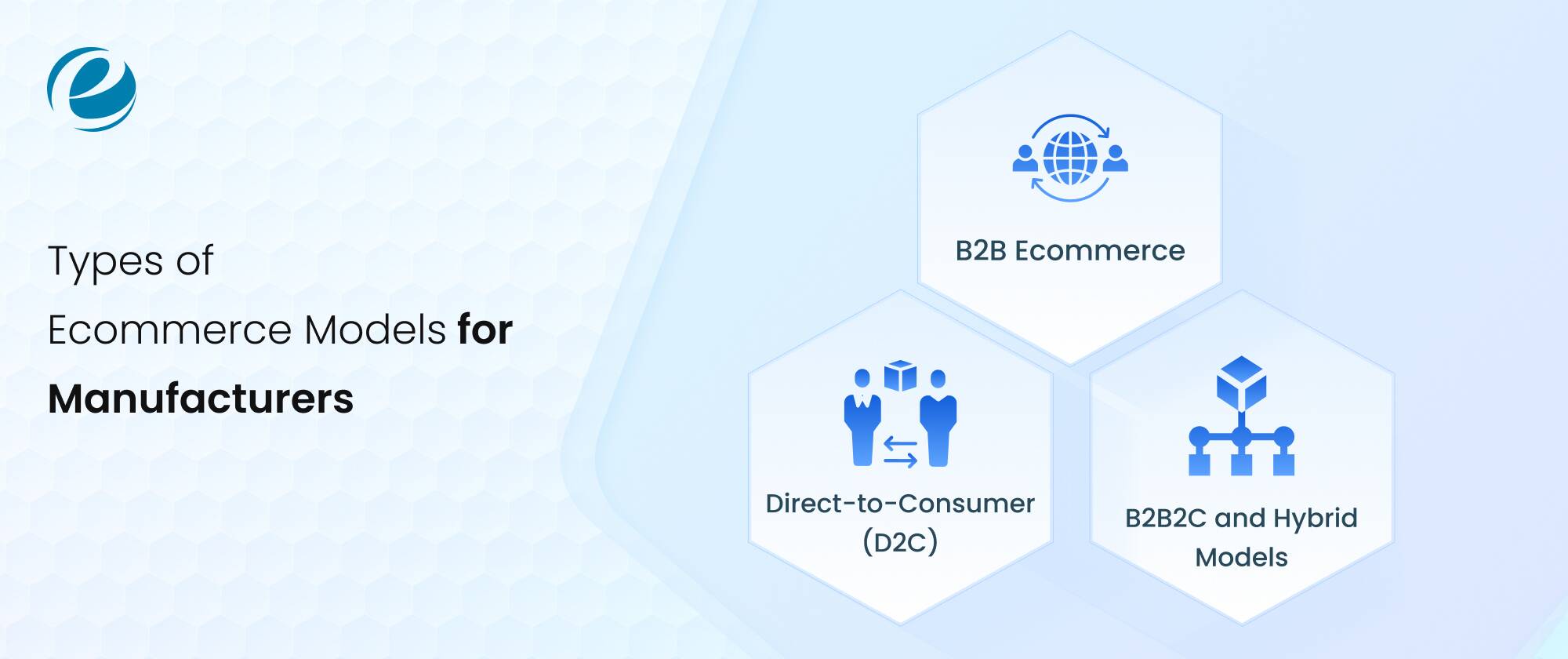
Not every manufacturer should sell online the same way. Understanding the broader types of ecommerce businesses helps clarify where manufacturing fits before choosing a model. The right model depends on existing distribution relationships, product complexity, and how much of the customer relationship the company wants to own directly. Many manufacturers end up combining more than one of these models, which is why platform flexibility matters so much later in this guide.
B2B Ecommerce
B2B ecommerce for manufacturers means selling directly to business buyers such as distributors, wholesalers, dealers, contractors, and OEMs through a digital purchasing portal. This is the natural starting point for most industrial companies because it digitizes relationships that already exist. It’s also where B2B ecommerce for manufacturing tends to pay back first.
A good B2B portal gives each account its pricing, credit terms, order history, invoices, and reorder tools. The buyer gets a quicker way to purchase. The manufacturer gets fewer manual orders, fewer data entry errors, and a sales team freed from processing routine transactions. This model fits industrial equipment, components, raw materials, spare parts, and wholesale product lines. For companies building their business from scratch, specialized B2B ecommerce website development matters because generic retail builds miss the account-level logic that makes B2B work.
Direct-to-Consumer (D2C)
D2C means selling to end customers through the manufacturer’s own storefront, without a retailer in between. The appeal is real: higher margins, direct customer relationships, full control over branding, and first-party data about who actually buys the product.
The costs are real, too. D2C means individual fulfillment, consumer returns, customer service expectations, and continued digital marketing spend. A manufacturer built around bulk shipments needs new logistics muscle before D2C makes financial sense. It is best suited to consumer product categories such as apparel, appliances, tools, and specialty goods, similar to how grocery ecommerce platforms serve everyday consumer demand.
B2B2C
B2B2C means the manufacturer sells through a business partner, such as a retailer or dealer, who then sells to the end consumer. The manufacturer typically supplies the products, catalog data, and the ecommerce technology behind the scenes, while the partner owns the storefront and the customer relationship. A dealer ordering portal, where dealers buy stock from the manufacturer, is B2B. B2B2C starts when the consumer’s purchase runs through the partner’s storefront.
The trade-off is control. B2B2C gives manufacturers consumer reach without building consumer-facing operations such as customer service and returns, but the partner usually keeps the shopper relationship and much of the customer data. In practice, this is ecommerce for manufacturers and retailers running on shared infrastructure: the manufacturer keeps product and inventory information consistent, and the partner handles the shopper.
Hybrid Models
A hybrid model means running two or more of the models above on one platform and one product catalog. A common example is a B2B portal for distributors and dealers alongside a D2C store for consumers, each with its own pricing, access rules, and fulfillment flow.
This is common in sectors like automotive, where an automotive ecommerce store might serve dealers, repair shops, and car owners from the same catalog with different pricing and access rules for each group. The same logic applies to sectors like healthcare, where a healthcare ecommerce website often serves providers, distributors, and patients differently. Hybrid setups like these allow manufacturers to grow online revenue without damaging the distributor relationships that still drive most of their business.
B2B Marketplaces
Marketplaces such as Amazon Business, along with industry-specific B2B marketplaces, are a separate model, and they can be either a channel or a threat. As a channel, they give manufacturers access to buyers who already start their product searches there, without building that demand themselves. As a threat, they put your products next to competitors’ on price-comparison terms, can weaken margins, and leave the marketplace, not you, holding the customer relationship and data.
Most manufacturers handle this by selling selected product lines on marketplaces while keeping their own portal as the home for contract pricing, configurable products, and their best accounts.
Benefits of Ecommerce for Manufacturers
The case for selling online is stronger than most manufacturing executives expect, and it goes well beyond “customers like websites.” The benefits below are supported by industry research. Each one affects revenue, cost, or customer retention.
Wider Market Reach Without New Sales Offices
An online channel allows a manufacturer to sell into new regions and customer categories without hiring local sales teams first. Smaller accounts that were never profitable to serve through field sales become profitable through self-service.
Revenue from Channels That Keep Growing
McKinsey’s 2024 B2B Pulse survey found that ecommerce ranked as the most effective sales channel for B2B companies for the fourth consecutive year and that self-service plus remote digital sales now generate about 34% of B2B revenue. Manufacturers disconnected from digital channels are absent from where the growth is happening.
Lower Cost per Order
Every order that flows through a portal instead of a phone call removes manual data entry, reduces errors, and cuts quote turnaround from days to minutes. Sales teams stop retyping purchase orders and start managing relationships, which is what they are actually good at.
Improved Customer Experience and Retention
Business buyers now expect the same ease of use they get as consumers: real-time stock visibility, transparent pricing on their account, order tracking, and 24/7 ordering. According to McKinsey research, B2B buyers employ ten or more channels in their purchase journey, and suppliers that miss the mark are swapped out fast.
Data the Business Never Had Before
Digital channels reveal which products get viewed but not bought, which accounts are slowing down, and what buyers search for that the catalog does not offer. That intelligence feeds demand forecasting, product development, and inventory planning in ways phone orders never could.
Readiness for AI Search, Product Discovery, and Agentic Buying
In 2026, buyers increasingly start with AI-assisted search rather than a supplier’s homepage, and procurement teams are beginning to use AI agents that research suppliers, compare specifications, and even reorder on their behalf. Digital Commerce 360’s 2026 B2B research covers agentic commerce as a growing part of the market.
For manufacturers, this raises the stakes on data quality. AI-powered on-site search can match natural-language queries, part numbers, and cross-references to the right product, and recommendation engines can surface compatible parts or replacements. But AI tools, whether yours or your buyer’s, can only recommend products whose specifications, availability, and pricing are structured, accurate, and available through clean APIs. A well-built ecommerce platform gives manufacturers that foundation, and a phone-and-PDF workflow doesn’t.
The pattern across all six benefits is the same. Ecommerce does not replace the sales team or the distributor network. It removes friction from routine transactions so humans can focus on the complex ones.
Common Challenges Manufacturers Face in Ecommerce
The benefits above come with honest difficulties, and pretending otherwise helps nobody. The reasons manufacturers’ ecommerce projects tend to fail are predictable, which is actually a good thing because you can plan for predictable problems. These are the top five most common.
Complex Products and Pricing
Manufacturers sell products with hundreds of variants, technical specifications, engineering drawings, and pricing based on volume, contract, and customer history. Standard ecommerce platforms assume simple products at fixed prices. Closing that gap requires configuration, CPQ tools, and careful data work.
Legacy System Integration
Many manufacturers still use ERP systems, such as SAP, NetSuite, Microsoft Dynamics, Epicor, or Infor, that are years, sometimes decades, old. Linking a new online store to this old back-end software is usually the hardest and costliest part of the whole project. When integration is done badly, the website shows wrong stock and wrong prices, and buyer trust disappears fast. An independent ecommerce audit before the project starts can surface these integration risks while they are still affordable to resolve.
Channel Conflict
When a manufacturer starts selling online, the dealers and distributors get nervous. And who can blame them? Companies that are good at managing these issues have clear rules in place, such as minimum advertised pricing, territories, exclusive product lines for dealers, or portals that send orders through partners rather than bypassing them.
Fulfillment Challenges
The transition from truckload to single-unit shipments alters warehouse operations, including packaging, carrier relationships, and returns processing. D2C in particular demands logistics capabilities most manufacturers have never needed.
Internal Resistance and Skills Gaps
A portal can be considered a threat to the commissions of the sales reps. Operations teams tend to distrust automation. Successful projects treat change management as seriously as technology, with training, clear communication, and commission structures that reward digital orders instead of punishing them. Many companies bring in ecommerce consulting services at this stage specifically to build the internal roadmap and get leadership aligned before any code gets written.
None of these challenges is a reason to avoid ecommerce. They are reasons to plan properly, budget honestly, and choose technology partners who have solved these exact problems before.
Choosing the Right Ecommerce Platform for Manufacturers
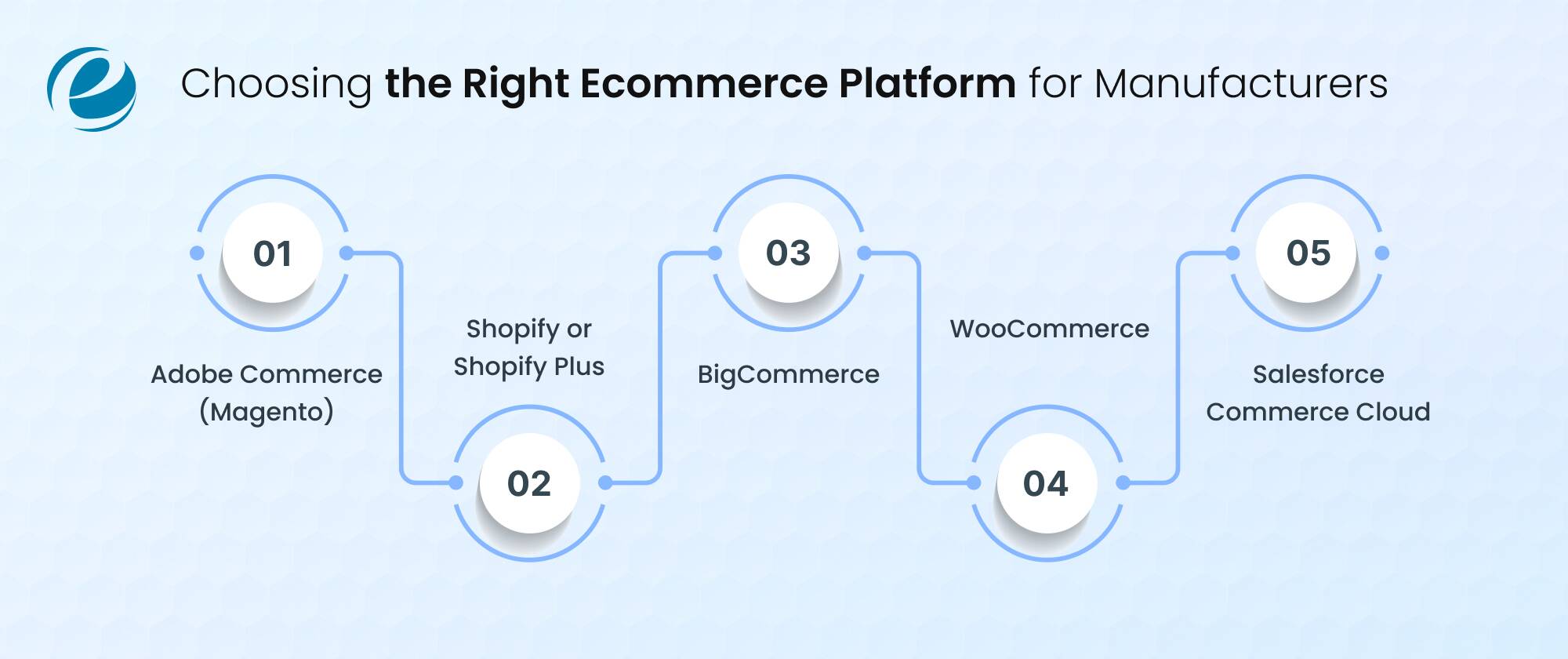
Platform choice affects everything that follows: cost, timeline, integration options, and how much the system can grow with the business. The truth is, there’s no single best platform for manufacturers, because a $10M components maker and a $2B industrial group have entirely different requirements. What follows is an honest look at the platforms that show up on most manufacturing shortlists, along with the type of company each one actually suits. A broader comparison of enterprise ecommerce platforms can help if the shortlist needs to go deeper.
The table below compares the five most common options side by side. Cost ranges are typical build costs, not licensing fees, and timelines assume ERP integration is included.
| Platform | Best fit | Native B2B features | Estimated build cost | Estimated timeline |
| Adobe Commerce (Magento) | Mid-market to enterprise manufacturers with large catalogs, multiple brands or regions, or unusual business rules | Company accounts, shared catalogs, negotiated pricing, requisition lists, quote workflows | $150,000 to $500,000+ | 6 to 12 months or longer |
| Shopify Plus | Manufacturers with simpler products, fast launch goals, or a mix of B2B and D2C | Company profiles, price lists, payment terms, and quantity rules (Plus only) | $50,000 to $150,000 | 3 to 6 months |
| BigCommerce (B2B Edition) | Mid-market manufacturers wanting strong native B2B without enterprise budgets | Customer-specific price lists, quote management, shared shopping lists, corporate accounts | $50,000 to $150,000 | 3 to 6 months |
| WooCommerce | Small manufacturers with limited budgets, simple catalogs, and an existing WordPress site | Added through plugins: wholesale pricing, quote requests, role-based catalogs | Below the standard B2B range for simple builds | Usually the shortest of the five |
| Salesforce Commerce Cloud | Large manufacturers already invested in Salesforce CRM and service | B2B commerce with contract pricing, account-based selling, complex order workflows | $150,000 to $500,000+ plus licensing | 6 to 12 months or longer |
Adobe Commerce (Magento)
Adobe Commerce is the leading option for complex B2B operations. It supports company accounts, shared catalogs, negotiated pricing, requisition lists, and quote workflows directly, and its open architecture means almost anything can be customized. Manufacturers with large catalogs, multiple brands, multiple regions, or unusual business rules tend to choose Adobe Commerce.
The honest downside is cost and complexity. Adobe Commerce needs experienced developers, real hosting infrastructure, and ongoing maintenance. It rewards companies with serious requirements and punishes companies that bought it for features they never use. Working with an experienced Magento development company can make the difference between a platform that delivers and one that becomes a maintenance burden. Best fit: mid-market to enterprise manufacturers with complex B2B needs and the budget to support them.
Shopify or Shopify Plus
Shopify wins on speed and simplicity, letting a manufacturer launch a basic storefront in just weeks. Shopify Plus has native B2B features such as company profiles, price lists, payment terms, and quantity rules. A full B2B rollout with ERP integration takes longer, typically 3 to 6 months, as outlined in the implementation section below. If you’re new to the platform, it helps to first understand what Shopify is and how its ecosystem works. Their app ecosystem covers most day-to-day needs, and they take care of all of the hosting, security, and updates for you.
Shopify isn’t built for everything, though. Once you’re dealing with heavy ERP integration, complicated product configurations, or pricing rules that don’t fit the standard mold, you’ll likely end up patching things together with workarounds. It tends to work best for manufacturers with fairly simple products or those aiming for D2C or a mix of B2B and D2C, especially when getting to market quickly matters more than having everything perfectly customized.
BigCommerce
For those needing a brief introduction to BigCommerce, see this brief introduction to BigCommerce. Its B2B Edition includes customer-specific price lists, quote management, shared shopping lists, and corporate account structures, with less dependence on third-party apps than Shopify and less development overhead than Adobe Commerce.
The ecosystem is smaller than its two bigger rivals, which occasionally means fewer ready-made integrations. Best fit: mid-market manufacturers who want strong native B2B functionality without enterprise-level implementation budgets.
WooCommerce
WooCommerce turns a WordPress site into a store, and its appeal for manufacturers is control and cost. If you’re thinking about this option, it helps to know what WooCommerce is before you compare it to other platforms. As open-source software, WooCommerce has no licensing fee and offers flexible hosting and B2B plugins for wholesale pricing, quote requests, and role-based catalogs. It’s the lowest-cost entry point for smaller manufacturers testing digital sales, provided the catalog and integrations stay simple.
The trade-off is responsibility. Security, performance, hosting, and plugin compatibility all fall on the company or its agency, and heavy catalogs can strain the platform. Ideal for: small manufacturers with limited budgets, simpler catalogs, and an existing WordPress presence.
Salesforce Commerce Cloud
Salesforce Commerce Cloud makes the most sense for manufacturers already running Salesforce CRM. Commerce, sales data, service cases, and marketing sit in one connected ecosystem, and the B2B Commerce product was built specifically for account-based selling with contract pricing and complex order workflows.
Licensing costs are high, and the platform assumes an enterprise budget and an enterprise team. Best fit: large manufacturers deeply invested in the Salesforce ecosystem who want commerce tied directly into CRM and service operations.
SAP Commerce Cloud
SAP Commerce Cloud suits large manufacturers whose operations already run on SAP. It is built for complex catalogs, multi-country selling, and deep integration with SAP ERP data such as pricing, inventory, and order status. As with Salesforce, it assumes an enterprise budget and an experienced implementation team. Best fit: global manufacturers standardized on SAP.
Other Manufacturing-Focused Platforms
Several other platforms are worth adding to a shortlist, depending on the profile of the business:
- Optimizely: a B2B commerce option popular with distributors and manufacturers that need strong catalog, pricing, and content management together.
- OroCommerce: built specifically for B2B, with account hierarchies, approval workflows, and quoting as core features.
- commercetools: an API-first, headless platform for companies that want to assemble their own composable stack.
- Sana Commerce: an ERP-connected storefront that reads pricing, stock, and orders directly from systems such as SAP, Microsoft Dynamics, and NetSuite, which reduces integration effort.
- Epicor and Infor storefronts: commerce modules from ERP vendors, a natural fit for manufacturers already running those ERPs who want tight back-office alignment.
Headless and Composable Architecture
Beyond choosing a platform, manufacturers now face an architecture decision: a traditional all-in-one platform or a headless or composable approach. In a headless setup, the front end (the storefront buyers see) separates from the commerce back end and connects through APIs. Composable commerce goes further, assembling best-of-breed components for search, pricing, cart, PIM, and checkout instead of relying on one suite.
The benefits are flexibility, faster front-end changes, and the ability to serve portals, mobile apps, punchout connections, and AI tools from the same back end. The costs are higher build complexity, more vendors to manage, and a heavier ongoing engineering commitment. Headless makes sense for larger manufacturers with multiple channels, unusual buying journeys, and strong technical teams. Smaller manufacturers with straightforward needs are usually better served by a full-featured platform. Adobe Commerce, BigCommerce, Shopify Plus, and Salesforce all support headless builds, and Commercetools is designed around it.
Whichever direction the evaluation goes, the platform is only half the decision. The implementation partner matters as much, and many manufacturers choose to hire ecommerce developers with proven manufacturing integration experience instead of general web agencies.
How to Implement an Ecommerce Solution for Manufacturing
A good platform will still fail if someone implements it poorly. The manufacturers who succeed follow a sequence that puts business goals and data preparation before technology, and they launch small before scaling. Here is a practical seven-step path that shows how successful projects actually run.
Step 1: Define goals and measurable KPIs: Decide what the channel must achieve: percentage of orders moved online, quote turnaround time, new market revenue, or cost per order. If field buyers are a target audience, note mobile ordering as a later-phase goal. Vague goals like “go digital” produce vague projects. The KPI and ROI section below shows how to calculate each of these.
Step 2: Map how customers actually buy: Interview distributors, dealers, and end buyers. Find out where they get frustrated, what self-service tools they would use, and what would make them order online instead of calling. Also ask which procurement systems they use, since large accounts may require punch-out catalogs or EDI. Their answers should shape the feature list, not a vendor demo.
Step 3: Get your product data in order first: Manufacturing product data is often distributed across ERP systems, spreadsheets, PDF datasheets, and other internal systems. Clean up specifications, images, documents, and pricing rules before you launch. Unorganized data on day one is the easiest way to lose a buyer’s trust. AI search and buying agents also rely on clean, structured data.
Step 4: Select the platform and integration architecture: Choose based on the model (B2B, D2C, or hybrid), catalog complexity, and ERP compatibility. Plan the ERP (SAP, NetSuite, Dynamics, Epicor, or Infor), CRM, and PIM integrations in detail at this stage, along with any punchout or EDI connections, since they drive most of the budget and timeline. Experienced ecommerce development services teams will insist on this integration planning early, and that insistence is a good sign.
Step 5: Give buyers the self-service tools they actually want to use: online ordering, pricing tied to their account, quote requests, order tracking, invoice downloads, and a smooth reordering process. If your products come in different configurations, don’t skip a good configurator; one that gets pricing and valid combinations right is worth the investment.
Step 6: Try it out with a small group first: Pick a few trusted accounts and run through the entire experience to ensure inventory levels are correct, pricing rules are being followed, checkout is smooth, and orders are syncing correctly to your ERP. Once you’ve worked out the bugs, roll it out to more customers in phases.
Step 7: Don’t stop after launch: Watch how adoption, conversion, order accuracy, and site performance trend over the following months, and be ready to act on what you find. Platforms need regular maintenance, whether that’s your own team handling it or bringing in ecommerce support services and ecommerce managed services to keep things running while your people focus on customers. Once the portal is working well, it’s the right time to launch ecommerce mobile apps for buyers in the field, as planned back in Step 1.
Measuring KPIs and ROI
Set your baseline before launch so the numbers mean something afterward. These are the core KPIs and how to calculate them:
- Online order share = online orders ÷ total orders × 100
- Portal adoption rate = accounts ordering online ÷ active accounts × 100
- Cost per order = total order-processing cost ÷ number of orders (calculate separately for online and manual orders)
- Quote turnaround time = time quote is sent − time quote is requested
- Order accuracy rate = orders with no errors ÷ total orders × 100
To calculate ROI:
- Annual net benefit = incremental gross profit + processing cost savings − annual running costs (hosting, licenses, support)
- ROI = (annual net benefit − total investment) ÷ total investment × 100
- Payback period (months) = total investment ÷ (annual net benefit ÷ 12)
For example, a manufacturer processes 20,000 orders a year manually at $25 per order. If 8,000 orders move online and the cost of processing an online order falls to $8, the annual processing cost savings would be $136,000.
Add $150,000 gross profit from new accounts, less $60,000 annual running costs. This would mean a net benefit of $226,000 per year. The first-year ROI would be 13%, and the payback would be about 10.6 months for an initial investment of $200,000. Substitute these numbers with your data when calculating your actual ROI.
For context, McKinsey’s 2024 B2B Pulse survey found approximately 34% of B2B revenue came from self-service and remote digital sales on average. This can provide you with a directional guide for online revenue share, but your target should be based on your product complexity, customer mix, and starting point.
Estimated timelines also depend on platform and project complexity. A B2B implementation on Shopify or BigCommerce may take 3 to 6 months, while a complex Adobe Commerce or Salesforce implementation with deep ERP integration can take 6 to 12 months or longer. The scope of real-time depends on the integrations, customization requirements, data migration, and testing.
Conclusion
Ecommerce for manufacturers is no longer an experiment for early users. With overall B2B sales nearly flat while digital B2B purchasing grows at double digits, the market has already decided how industrial buying will work. The only open question is which manufacturers will own their digital channel and which will watch buyers move to competitors and marketplaces.
The winning approach is consistent across successful projects. Pick the business model that fits existing distribution relationships. Choose a platform matched to real complexity, not aspirational complexity. Treat ERP integration and product data as the core of the project instead of an afterthought.
Conduct trials with real customers, manage the internal change honestly, and keep improving after launch. Manufacturers who get this right gain lower selling costs, wider reach, loyal customer relationships, and data their competitors do not have. Those advantages compound every year. The best time to start building was three years ago. The second best time is now.
FAQs
What is ecommerce for manufacturers?
Ecommerce for manufacturers is the use of digital platforms to sell industrial or manufactured products online to business buyers, consumers, or both. It supports capabilities unavailable to standard retail stores, like account-specific pricing, bulk ordering, quote workflows, and ERP integration.
Why do manufacturers need ecommerce platforms?
Business buyers now want to be able to research, compare, and order online. Ecommerce was the most effective B2B sales channel for the fourth year in a row, according to McKinsey’s 2024 B2B Pulse survey. Manufacturers that don’t have a digital channel are losing orders to competitors and to marketplaces that do.
Which is the best ecommerce platform for manufacturers?
There is no universal best. Adobe Commerce suits complex enterprise B2B needs, Shopify Plus suits fast launches and hybrid models, BigCommerce fits mid-market B2B, WooCommerce fits smaller budgets, and Salesforce Commerce Cloud fits companies already invested in Salesforce.
What is B2B ecommerce for manufacturers?
Think of it as taking distributor and dealer relationships that used to run on phone calls and emails and moving them online. Each buyer logs into their portal with their pricing, credit terms, and order history, so purchasing feels quicker for everyone.
Can manufacturers sell directly to customers online?
Yes, that's what the D2C model is for. Manufacturers create their own online shop and sell directly to the end customer, thus achieving better margins and real customer data. The catch is you'll need to handle single-unit shipping, returns, and support that a B2B setup never required.
How much does manufacturing ecommerce development cost?
It depends a lot on how complex the build is. Most standard B2B ecommerce builds cost somewhere between $50,000 and $150,000, while enterprise setups with heavy ERP work and multi-warehouse support can climb past $500,000. A lean WooCommerce build for a small, simple catalog can come in below that range. Integration needs, catalog size, and developer rates all affect where a project falls on that scale.
What features should an ecommerce platform for manufacturers include?
Look for customer-specific pricing, bulk and quick ordering, quote or CPQ tools, purchase order payments, approval workflows, real-time inventory, and solid ERP, CRM, and PIM integration. If your buyers order through procurement systems, punchout catalog and EDI support matter too. When products are configurable, a good product configurator can make a real difference.
How long does it take to build an ecommerce solution for manufacturing?
A standard B2B storefront on Shopify Plus or BigCommerce usually takes 3 to 6 months to launch. Complex builds like Adobe Commerce or Salesforce with deep ERP integration typically take 6-12 months, sometimes longer for multi-region deployments.



 +1 (989) 535-9295
 info@emizentech.com
 emizentech


