
 Add us as a preferred source on Google
Key Takeaways
- Offshore web development typically cuts costs by 40-60% compared to onshore hiring.
- 2026 hourly rates range from $15 to $50 depending on the region.
- A dedicated offshore team suits long-term products; fixed-price suits short, well-defined ones.
- The global offshore software development market is on track to hit $204.32 billion in 2026 at a compound annual growth rate of 14.6%.
- Clear requirements and overlapping working hours are the two biggest predictors of a smooth project.
Offshore web development means hiring a development team based in another country, usually one with lower operating costs, to build your website or web application. It’s become the default move for startups stretching a tight budget and for bigger companies that want to scale a product without hiring more staff, cutting costs by 40-60% while tapping into skills that just aren’t available locally. In this guide, you will learn what the model actually is, how it compares to nearshore and onshore development, what it costs in 2026, and how to pick a partner without the usual back-and-forth.
What is Offshore Web Development?
Offshore web development is basically about outsourcing to a company or team located in a different country to build a website or web app, usually a good stretch away in both cost and time zone.
Here’s how the actual engagement works out:
- Firstly, the client shares requirements and a rough budget.
- After that, the offshore partner assigns developers, a designer, and a project manager to match the scope.
- Both sides work through Jira, Slack, and GitHub instead of walking over to someone’s desk.
- Updates happen over scheduled calls, async status notes, and shared docs rather than hallway conversations.
- Larger organizations often go a step further and set up a dedicated offshore development center, where the offshore unit becomes a permanent extension of the in-house team.
Pro Tip: Start every engagement with a written brief. Vague verbal requirements are the number one reason offshore projects drift off scope and blow past deadlines.
Offshore vs. Nearshore vs. Onshore Web Development: Key Differences
These three hiring models differ mainly by location, cost, and time zone overlap. Offshore costs the least and offers the widest talent pool, while onshore offers the easiest same-hours communication. Here is a brief description:
1. Onshore: The team works in your country. Easiest communication, full overlap, highest price tag, and honestly the smallest talent pool to pick from.
- Cost: $80-$150 per hour
2. Nearshore: The team sits in a nearby region, a US company working with a team in Latin America, for instance. Decent savings, partial overlap, and travel are manageable if you ever need it.
- Cost: $40-$80 per hour
3. Offshore: The team is somewhere far off, like a US or UK company partnering with developers in India or Southeast Asia. Offshore offers the biggest savings and the largest talent pool, but there is little to no overlap in working hours.
- Cost: $25-$50 per hour
Some companies split the difference by using offshore execution with nearshore leadership, achieving cost savings while maintaining oversight. For a fuller breakdown of the trade-offs, this comparison of onshore vs nearshore vs offshore development is worth a read.
Offshore Web Development Team Structure
Most offshore development companies give you two structural options: a project-based team put together for a fixed scope or a dedicated team that works only on your product long-term, basically functioning as an in-house extension.
The dedicated model tends to win out for products with ongoing feature work, since the same developers keep full context of the codebase instead of relearning it every time something new comes in. So, basically, if you want a successful team of professionals, then you should know how to structure an offshore team from scratch.
Reporting structure matters just as much as headcount, if not more. A well-run team has one project manager who owns the sprint board, reports progress weekly against the roadmap, and flags blockers before they eat an entire sprint cycle, not after the fact.
Offshore Web Development Process: Step-by-Step
A successful offshore web development project requires proper planning, communication, and management. Below here is a list of eight steps that you can utilize for the web development:
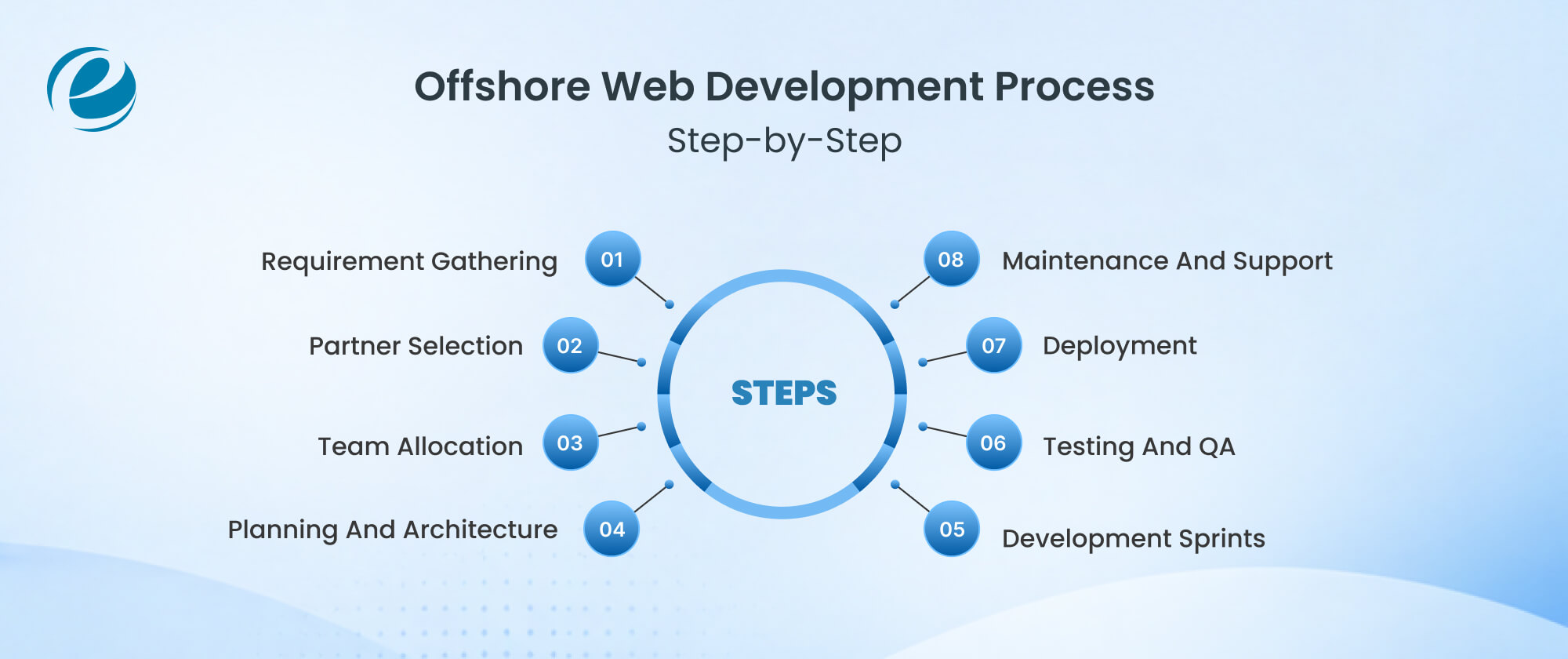
- Requirement gathering: Define project scope, tech stack, target audience, timeline, and budget in a written brief.
- Partner selection: Shortlist companies based on portfolio, client reviews, technical expertise, and how well they communicate.
- Team allocation: The vendor assigns developers, a project manager, and QA resources matched to your stack.
- Planning and architecture: Wireframes, sprint planning, database design, and technical architecture get locked in before anyone touches code.
- Development sprints: Code is built in one- to two-week sprints, with a working demo at the end of each one.
- Testing and QA: Functional, performance, cross-browser, and security testing run before every release, not just at the very end.
- Deployment: The app moves from staging to production, with a rollback plan sitting ready in case something breaks.
- Maintenance and support: Bug fixes, security patches, and feature updates continue after launch under an SLA.
Most established providers also run a short discovery phase before step one, a paid or free technical audit that confirms feasibility and gives a firmer estimate than a first-call quote ever could.
How Much Does Offshore Web Development Cost in 2026?
Offshore web development costs in 2026 range from roughly $15 to $50 per hour depending on the region. In this table, you will see the rates by region in 2026:
| Region | Approximate Cost |
| South Asia (India) | $15-$35 per hour |
| Latin America | $35-$75 per hour |
| Eastern Europe | $40-$80 per hour |
| United States | $80-$150 per hour |
So, offshore web development cost swings on a handful of factors: project complexity, the tech stack chosen, team size, engagement model, and which country the partner is based in.
How AI-Assisted Web Engineering Lowers Development Costs?
AI tools are cutting into offshore billable hours, and that’s worth knowing before you sit down to negotiate a rat. Work that used to be repetitive code, test cases, and documentation now gets handled with AI assistance.
Here are some areas where the savings actually show up:
- Code generation: AI handles repetitive coding, CRUD, API routines, and standard UI, which cuts down on junior-level hours.
- Automated testing: AI-generated test cases catch bugs before manual QA even starts, so that line item shrinks.
- Documentation: Auto-generated docs and change logs remove hours that used to sit under admin.
- Faster code review: AI catches common issues early, leaving senior developers free for architecture work instead of hunting typos.
However, the providers who use generative AI well end up quoting lower for the same scope or giving you more scope for the same money. It’s also part of why some offshore providers are moving toward outcome-based pricing instead of straight hourly billing.
Pro Tip: Ask providers how AI actually factors into their pricing. If they can’t give you a specific answer, odds are they’re still billing hourly for work that shouldn’t take that long anymore.
Offshore Development Hiring Models Explained
Offshore development teams are typically hired through three models: fixed-price, hourly/time-and-material, or a dedicated team on a monthly rate, each suited to a different project type, and each comes with its own pricing logic.
- Fixed-price model: Best for well-defined, short-term projects with a locked scope. Payment ties to milestones, though it limits flexibility if requirements shift mid-project.
- Hourly / Time & Material model: Best for evolving requirements. You only pay for hours actually worked, which is flexible but needs closer budget tracking on your end.
- Dedicated offshore development team model: Best for long-term products. You pay a monthly rate per developer, and the team works exclusively on your project with full continuity, sprint after sprint.
Most businesses building something long-term go with the dedicated team model because it balances cost control with continuity and keeps institutional knowledge of the codebase intact. There’s also a fourth option some providers offer: staff augmentation, where individual specialists slot into your existing in-house team instead of working as a standalone unit.
That’s handy if you already have a project manager and just need more engineering hands. Ready to move forward? You can directly hire dedicated developers or specifically hire web developers under whichever model fits your budget.
Offshore Web Development Best Practices
The best practices for offshore web development are clear requirements, overlapping working hours, agile sprints, strict code review standards, a trial project first, and one accountable point of contact.
It’s a short list, but it covers most of the issues that actually arise on offshore projects.
- Define clear requirements: Vague specs are the single biggest cause of offshore delays and rework, hands down.
- Overlap working hours: Even 2-3 overlapping hours a day can speed up decisions considerably.
- Use agile sprints with regular demos: Weekly check-ins keep the project visible and catch misalignment early, before it snowballs.
- Set up code review and version control standards: Protects quality and consistency across a team that isn’t sitting in the same room.
- Start with a trial project or a smaller module: Test technical skill and communication style before committing to the full scope.
- Document everything: Requirements, decisions, and change requests. Write it down; don’t just say it on a call.
This checklist is essentially what makes offshore development predictable instead of a gamble, and it’s the same list experienced buyers run through before signing anything.
Common Challenges in Offshore Web Development
The most common offshore web development challenges are mentioned below. You have to understand that every model has friction points. Here’s what usually comes up and how to fix it.
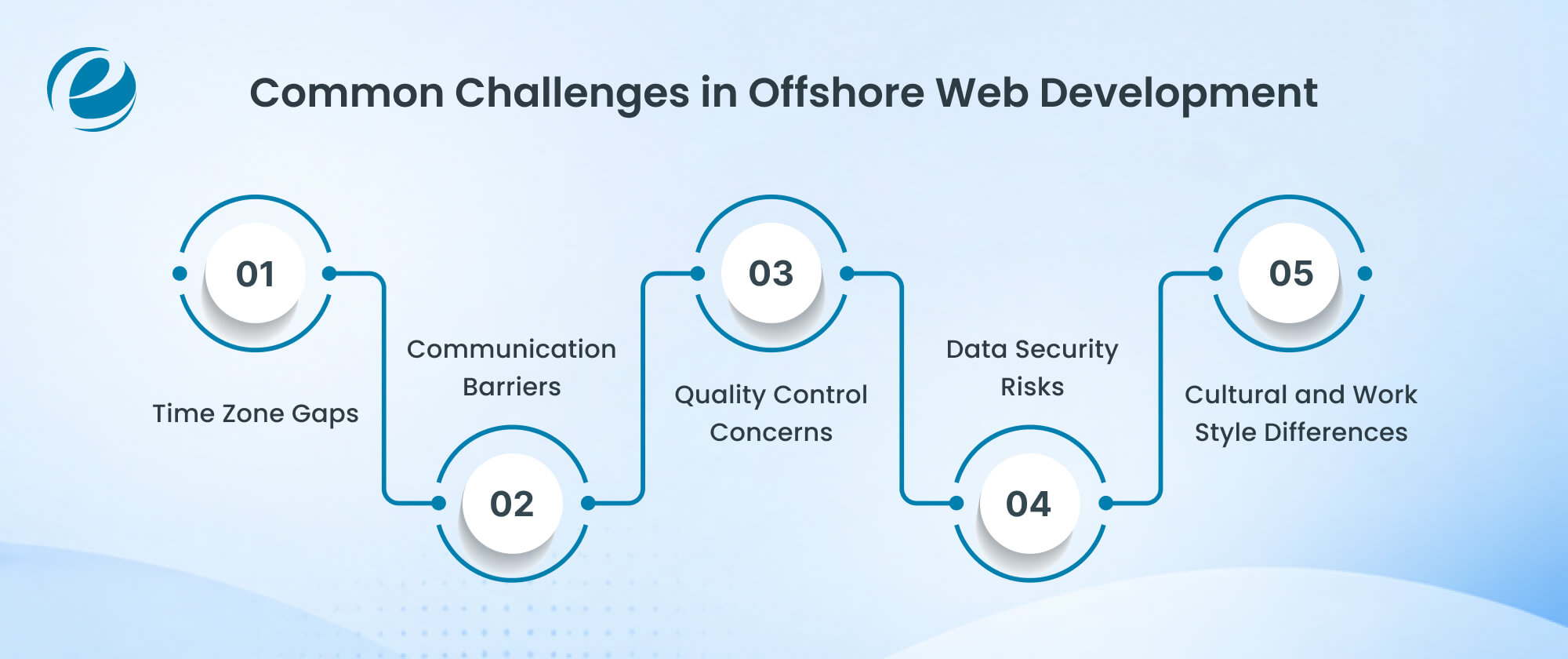
Time Zone Gaps
You know that different time zones can slow down communication and decision-making. For that, you should set overlapping working hours, schedule regular meetings, and use project management tools.
Communication Barriers
There are differences in languages, communication styles, or unclear requirements that can lead to misunderstanding. Ensure that you maintain clear documentation and define project goals early
Quality Control Concerns
It can be challenging to maintain the expected quality when teams work remotely. So choose experienced development partners, set clear quality standards, and conduct regular code reviews and testing.
Data Security Risks
Sharing sensitive business information with an offshore team may create security concerns. You can use secure tools, sign confidentiality agreements, and follow strong data protection practices.
Cultural and Work Style Differences
The developers’ team may have different approaches to work, feedback, and deadlines that can affect collaboration. So build a strong working relationship, respect cultural differences, and establish shared processes.
These are the same friction points that come up with any distributed team, offshore or not, and they’re worth reading more about in this breakdown of the challenges of hiring dedicated developers.
Future Trends in Offshore Web Development
Offshore development in 2026 looks different from even two years ago, mostly thanks to AI tooling and tighter compliance expectations. Here are some of the future trends that can change offshore web development in the upcoming years:
AI-Assisted Development
AI coding tools, automated testing pipelines, and cloud-native architectures are cutting delivery timelines while keeping code more consistent across teams. Routine coding, testing, and documentation work is increasingly automated, which frees up human developers to focus on architecture, security, and the trickier business logic that AI still can’t handle well.
Hybrid Team Models
More businesses are combining an offshore team for execution with onshore or nearshore leads for oversight. It’s a way to keep tighter quality control without giving up the cost savings offshore brings.
Compliance-First Partnerships
Data security compliance with GDPR, SOC 2, and ISO 27001 is turning into a baseline requirement rather than a nice-to-have when picking a partner, as regulators and enterprise clients tighten expectations around where and how code and data get handled.
Outcome-Based Pricing
As AI absorbs more routine coding work, some offshore providers are moving away from pure hourly billing toward pricing tied to sprint deliverables instead. That gives clients steadier budgets and keeps the vendor’s incentives closer to the actual product roadmap.
Why Choose EmizenTech for Offshore Web Development?
EmizenTech is a full-stack web and mobile app development company running dedicated offshore teams with transparent pricing that starts from $20 per hour and NDA-backed data security with complete IP ownership.
Here’s what clients actually get:
- Flexible hiring models: fixed-price, hourly, or dedicated team.
- Direct access to developers instead of layered account managers.
- Post-launch support included by default, not sold as an add-on.
- Weekly reporting, a dedicated project manager, and full source code ownership are included.
- Experience across fintech, healthcare, retail, and logistics.
For anyone evaluating an offshore web development company, EmizenTech is a fairly low-risk place to start: begin with a small module or MVP, see how the team communicates and delivers, then scale once the fit feels right.
With full source code ownership and a 14-day money-back guarantee, you are not locked into anything before you have seen the work. You can hire a dedicated app development team directly to see how the engagement actually works before committing to anything larger.
Final Thoughts
Offshore web development is still one of the most cost-effective ways to build and scale a website or web application in 2026 as long as you pick the right partner, hiring model, and communication setup from day one. The businesses that get the most out of it treat their offshore team as an extension of their own, not as a vendor they check in on once a month, with clear requirements and QA checkpoints at every stage.
FAQs
What is offshore web development?
It means outsourcing website or web app projects to a development team in another country, usually to reduce cost and access specialized technical talent.
What does offshore development typically cost?
Pricing usually ranges from $15-$50 per hour depending on the country, with full projects costing $8,000-$100,000 or more based on complexity.
Is offshore web development safe for data security?
Yes, if the company signs an NDA, uses secure infrastructure, and follows recognized compliance standards like GDPR or ISO 27001 throughout the engagement.
How do I choose the best offshore web development company?
Check their portfolio, client reviews, technical stack expertise, communication process, and whether they offer a trial project before full commitment.





 +1 (989) 535-9295
 info@emizentech.com
 emizentech


