
 Add us as a preferred source on Google
 If you asked two decades ago what customer relationship software meant. Everyone would have gone blank. Because that term never existed, and everyone used to do the work manually, not just at home but at businesses too, be it handling clients, maintaining professional relations, conducting sales, or even managing an organization’s employees. Then what brought the term into existence? The answer: manual processes are redundant, error-prone, and lack transparency.
Businesses started noticing issues daily, and routine operations became no less than a task. Also, as businesses expanded, relying on manual work and expecting exponential productivity was like aiming with your eyes closed. This is when a CRM system comes to the rescue: digital software that centralizes all the tasks in one place. But leveraging such a solution comes with a basic problem: how do you use it?
This is when CRM managers are hired to manage CRMs and run knowledge-transfer sessions for other employees. In this blog, we will discuss the role of a CRM manager in detail, their skill sets, and their salary.
What Does a CRM Manager Do?
Often, the roles and responsibilities of a CRM manager are subjective. Since every CRM software and tool differs from organization to organization, the roles vary. However, the baseline remains the same. To highlight what a CRM manager does, you can check the pointers mentioned below:
- Maintaining client records in the CRM system ensures transparency and accuracy.
- Monitoring customer behavior
- Handling the team of sales executives and representatives
- Contacting elite clients and customers
- Resolving customer queries and complaints raised
- Coordinating interdepartmental presentations and meetings
- Evaluating strategy implementation in real-time
- Working with the IT department to solve issues related to CRM software
To be a CRM manager, you need a strong command of sales, marketing, and customer service and related fields. However, if your aim is to serve in this area lifelong, then it’s essential to have an understanding of CRM managers’ job description and long-term duties, which are as follows:
- To deliver a seamless customer experience, you need to be on your toes. To do that, collaborate with internal departments to offer enhanced customizations and implement best practices for the end user.
- Work closely with sales and marketing experts to create more opportunities to enhance CRM platforms and their integrated systems.
- Optimize the full capabilities of CRM software by training internal teams.
- Timely development and restructuring of CRM procedures, training processes, and implementation.
Essential Skills Required to Be a Successful CRM Manager
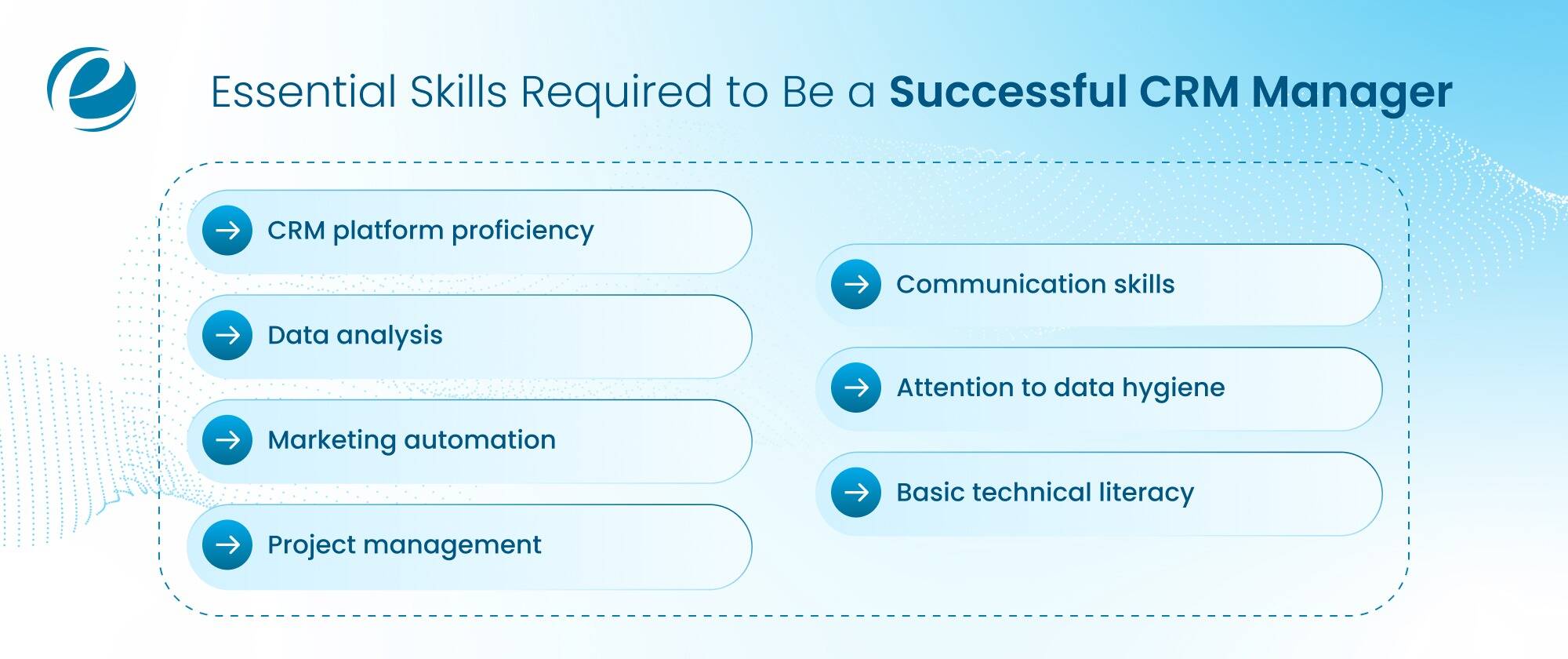
The skills that actually matter to be a successful CRM manager combine technical fluency with real business judgment. Here’s what separates people who excel in this role from those who just have the title:
CRM platform proficiency
You have hands-on configuration experience with tools like Salesforce, HubSpot, or Zoho, not just knowing how to log in and click around.
Data analysis
When you are comfortable enough with dashboards, basic SQL, and spreadsheet modeling to question the numbers instead of just accepting them.
Marketing automation
If you have built trigger-based campaigns, lead scoring, and segmentation logic that actually reflects how buyers behave, not just what looks tidy on paper.
Project management
You can handle juggling rollouts, migrations, and integrations across several teams at once, usually with more moving parts than one person can really hold in their head.
Communication skills
Easily translating technical constraints for non-technical stakeholders and translating business goals back into system logic.
Attention to data hygiene
You have a near-obsessive discipline around clean, consistent records, because one messy field can throw off an entire report.
Basic technical literacy
Must have enough grasp of APIs and integrations to brief a developer without a week of back-and-forth.
So, these are some CRM manager skills that startups and SMBs look for when they are vetting the specialists in customer relationship management.
CRM Managers Salary Benchmarks
Pay varies a lot by region, company size, and how complex the platform setup is. A fast-growing SaaS startup and a large retail chain rarely pay the same rate for this position. Here’s roughly where things stand right now across a few major markets:
| Region | Junior | Mid-level | Senior |
| United States | $70,000 – $88,000 | $102,000 – $115,000 | $130,000 – $160,000+ |
| United Kingdom | $65,000 – $75,000 | $85,000 – $95,000 | $105,000 – $120,000+ |
| Asia (India) | $18,000 – $22,000 | $27,000 – $32,000 | $35,000 – $50,000+ |
A few things consistently push pay higher regardless of region: managing an enterprise-grade platform like Salesforce instead of something lighter, owning integrations across multiple systems, and having a track record of actually moving retention or pipeline numbers.
Businesses keep investing in CRM because it keeps paying off; Salesmate’s 2026 CRM statistics roundup points to the global CRM market being on track to reach roughly $126.17 billion in 2026, driven by continued demand for software that strengthens customer relationships, sales execution, and service operations.
Top CRM Platforms to Know About in 2026
Many candidates looking to build careers in this domain often ask: How to become a CRM manager? The best CRM managers and experts know the types of CRM software and trending CRM platforms companies demand most. For the year 2026, these CRM platforms are widely popular:
Salesforce
Salesforce is a complete ecosystem for CRM products. It primarily involves a company’s sales and marketing applications, such as Salesforce integration services, Sales Cloud, Commerce Cloud, and IoT services. It is a best-in-class solution for customer management. In addition to its core features and functionality, Salesforce offers AI-based analytics tools called Einstein.
Creatio
The core ideology behind building Creatio was that people and AI agents should work together. It is an AI-enabled CRM and workflow platform. Such platform systems are ideal for midsize and large organizations across financial services, public sector, telecommunications, manufacturing, pharma, transportation, retail, and beyond. As a CRM, it revolves around three purpose-built products: marketing, sales, and service.
Hubspot
HubSpot is the preferred choice of small business owners; you can also say it’s a CRM for small businesses. Its core functionalities are completely free to use. However, the added features and integration capabilities, such as enterprise licensing, are chargeable. HubSpot also features platforms and solutions for sales, service, content management, and operations. Small businesses prefer it as a CRM solution because it comes with efficient data storage limits and a generous number of contacts.
Zoho CRM
Zoho is one of the leading MNCs (multinational companies) with expertise in services such as software development, cloud computing, and web-oriented business tools. It provides an extensive range of products and applications across major business areas like sales, marketing, HR, financial management, customer service, and other back-office operations. Many people think about Zoho vs. Salesforce: which CRM is better? The answer depends on how you want to use the particular platform. The Zoho CRM suite includes journey orchestration, marketing automation, sales enablement, analytics, process management, and more.
Microsoft Dynamics 365
Microsoft Dynamics 365 is known for offering much better capabilities than traditional CRMs. Its main focus is on providing seamless customer support compared to its competitors. Through this CRM solution, businesses get an overall view of customers, flexible support models, predictive analysis capabilities, and AI tools and functionality. It can also be easily integrated with other Microsoft products. With deployment options suitable for small, medium, and enterprise-level businesses, this product is viable for almost any business, regardless of its size or needs.
Pipedrive
Pipedrive is an easy-to-use CRM tool for sales executives. Here, they can manage leads, monitor communications, automate tasks, and measure key performance indicators (KPIs). Other features include a visual sales pipeline, a mobile app, dashboards, and email marketing campaigns. You can easily integrate it with other platforms such as Slack, Zoom, HubSpot, and more.
How to Hire the Right CRM Manager for Your Business
Hiring well for this role starts with being honest about what it actually needs to cover. Getting specific about scope before you even write the listing saves time on both sides of the interview table. A few practical steps to hire the right CRM manager:
Step 1: Define the scope first: You have to decide whether you need someone focused on strategy or hands-on admin, or both, and then write the job description around that decision, not the other way around.
Step 2: Prioritize platform-specific experience: Someone who’s already administered your exact CRM will ramp up faster than someone who hasn’t touched it before.
Step 3: Test for data judgment: Ask candidates how they’d approach a messy, duplicate-heavy database. The answer tells you more about their real skills than any certification will.
Step 4: Check cross-functional experience: The strongest candidates have actually worked closely with both sales and marketing, not just camped out on one side.
Step 5: Clarify reporting expectations upfront: Make sure the candidate knows exactly which dashboards and metrics leadership is going to look at every month.
If your business runs on custom workflows or needs deeper platform customization, it’s worth looking into CRM software development alongside the hire, since some needs go beyond what one administrator can build solo.
CRM Management: In-House vs. Hybrid Model
In the below section you are going to learn about the difference between an in-house CRM manager and a hybrid model and what impact it has on your platform:
In-house CRM Manager
An in-house hire brings institutional knowledge and consistent day-to-day ownership, both of which are genuinely valuable. However, relying on a single hire for the entirety of a CRM’s needs introduces structural risk. Heavy customization, complex integrations, and large-scale migrations typically require development expertise that extends beyond standard administration.
A single hire can also become an operational bottleneck: when that person is unavailable, overloaded, or the work exceeds their technical scope, projects stall until they return. Turnover compounds this exposure, since departing employees often take significant institutional knowledge with them regarding why the system is configured the way it is.
Hybrid Model
The most effective and increasingly common structure pairs a strategic, in-house CRM expert with an experienced technical partner responsible for heavy development, ongoing maintenance, and custom automation. Under this model, the in-house role focuses on strategy, day-to-day data quality, and stakeholder alignment.
This division of labor gives organizations consistent internal ownership alongside on-demand access to deeper technical capability, without the fixed overhead of maintaining a full in-house development team that would otherwise sit idle between major initiatives.
Here is a short comparison table that clearly shows the differences and resolves any doubts related to this theory.
| Factor | In-house CRM manager | Hybrid Model |
| Strategic ownership | Present but stretched across competing priorities. | Maintained and focused exclusively on strategy. |
| Custom development capacity | Limited or unavailable. | Full development team available on demand. |
| Cost predictability | Fixed salary with capped output. | Scales in line with project scope. |
| Speed on complex builds | Slower, it competes with daily operational work. | Faster, supported by dedicated resources. |
| Risk if the role sits vacant | Higher because of a single point of failure. | Lower because partner continuity remains in place. |
With the help of this quick table, you may understand the in-house CRM and hybrid model with the help of a company so that you can make proper decisions for your platform.
Common Challenges CRM Experts Face
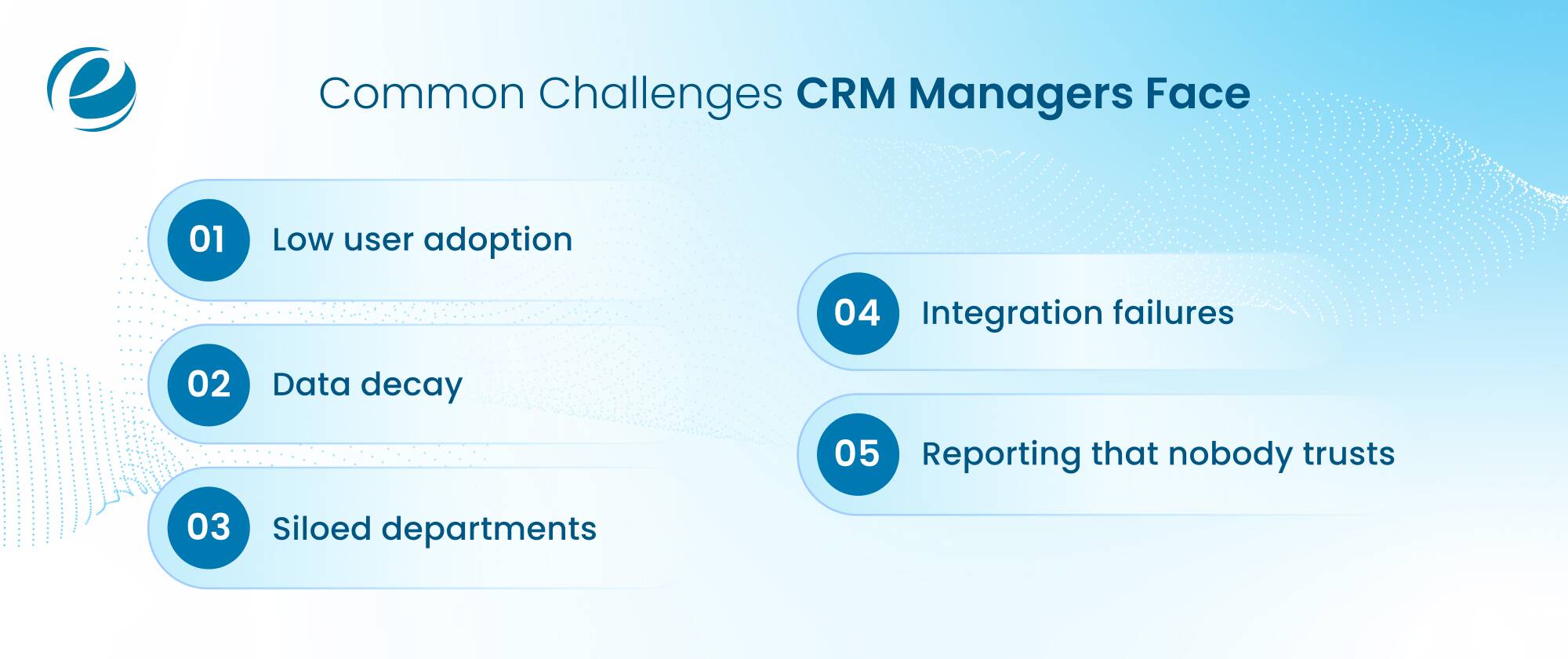
Even a well-configured system runs into friction once real teams start using it every single day. Here’s what tends to come up most and what actually tends to fix it.
Low user adoption
The sales team skips data entry the moment a tool feels like extra work on top of their real job. To fix this, simplify required fields and tie CRM usage to something reps already care about, accurate commission tracking.
Data decay
Contact details go stale fast, especially in industries with high job turnover. Scheduled cleanups and validation rules catch this before it turns into a much bigger reporting mess.
Siloed departments
Marketing and sales often can’t even agree on what counts as a “qualified lead.” Getting both sides to settle on shared definitions solves more friction than any piece of automation ever will.
Integration failures
APIs break. Updates cause conflicts. This phase is usually where an internal hire needs backup from developers who work in the codebase daily rather than occasionally.
Reporting that nobody trusts
If the underlying data is messy, dashboards turn into decoration instead of decision-making tools. Fixing data hygiene must come before fixing reports; there is no shortcut here.
Therefore, it is necessary to overcome these challenges if you want to grow in this field without making any mistakes.
Why Businesses Partner with Emizentech for CRM Solutions
Emizentech works with businesses that have outgrown basic CRM setups and need real customization, integration, or a complete rebuild. The team has delivered CRM projects across retail, healthcare, and logistics, connecting platforms like Salesforce and Zoho with eCommerce stores, ERPs, and custom internal tools.
That range matters, because most CRM problems aren’t actually platform issues; they are integration problems, and solving them takes developers who know CRM’s data model.
Our clients consistently point to responsive communication, technical depth, and delivery that stays on schedule, and that reputation holds up in independently verified client reviews on Clutch, where ratings reflect steady, repeatable outcomes rather than marketing copy.
What this process looks like in practice:
- Custom CRM development – Paltforms built around specific workflows instead of generic templates that need constant workarounds.
- Integration work that connects CRM platforms cleanly with existing business tools, from ERPs to eCommerce backends.
- Ongoing maintenance and support so an in-house team isn’t putting out technical fires on top of their daily strategy work.
- Scalable builds that grow with the business instead of needing a rebuild every couple of years.
For businesses still weighing their options, best CRM solutions for your eCommerce store is a useful next read before committing to a platform or a partner.
Conclusion
A CRM manager sits at the intersection of strategy, data, and technology, owning everything from retention campaigns to system integrations. The role keeps growing in importance as customer expectations rise and CRM platforms get more sophisticated. For businesses still wondering whether their operation genuinely needs one, it usually comes down to complexity: once customer data and sales workflows outgrow what anyone can manage by instinct, dedicated ownership starts paying for itself.
FAQs
What is the difference between a CRM manager and a CRM administrator?
This role owns strategy, retention, cross-team alignment, and reporting, while a CRM administrator focuses more narrowly on technical upkeep, user permissions, data fields, and system configuration. Many small businesses combine both into one role.
What qualifications do you need to be a CRM expert?
Most people in this role hold a degree in marketing, business, or a related field, paired with hands-on platform experience. Salesforce or HubSpot certifications help on paper, but practical experience with real customer data tends to matter more to employers.
Does a small business need a CRM manager?
Small businesses with a few hundred contacts can often get by without one. Once customer data, sales pipelines, and marketing automation grow complex enough to need daily oversight, though, hiring one turns into a clear return on investment rather than an added expense.
Can a CRM expert help with custom CRM development?
They can scope requirements and manage the relationship, but heavy custom development usually needs a technical partner. Pairing an in-house hire with a development team like Emizentech covers both strategy and execution without overloading either side.


 +1 (989) 535-9295
 info@emizentech.com
 emizentech


